

Most leaders do not need a philosophical definition of data governance. They need a simple answer to one question:
Can we use our data to run the business confidently, without accidentally breaking trust, law, or reality?
Data governance is what makes that answer “yes.”
A plain-English definition:
Data governance is how a company assigns decision rights and accountability over data, so teams can move fast with confidence.
It covers who decides what data means, who can access it, how it may be used, how long it is kept, how quality is maintained, and how all of this is proven through documentation and auditability.
Governance is not paperwork for its own sake. It is clarity, at scale.
What governance is not
You will hear data governance used interchangeably with other topics. That creates confusion and, honestly, bad programs.
Data security protects data from unauthorized access or loss.
Data quality makes data accurate, complete, consistent, and fit for purpose.
Compliance ensures you meet legal and regulatory obligations.
Data engineering builds pipelines, models, and platforms that move and transform data.
Governance is the operating model that coordinates all of the above. It defines ownership, rules, controls, and evidence. Without governance, you might still have smart engineers and well-meaning teams, but the organization relies on tribal knowledge and luck.
The promise to CEOs, COOs, and business owners
Governance brings clarity. At any moment, you can tell what you can safely do with data without risking reputation, losing client trust, or triggering compliance issues.
It reduces “data roulette,” the situation where everything looks fine until one incident exposes how fragile the system really is.
A fast diagnostic: Pull One Thread
If you want to know whether governance exists in practice, pick a single metric in a dashboard and ask the questions below. You do not need perfect answers. You need answers that exist, are documented, and are owned.
Example metric: Units sold
Ask:
Scope and time frame: Units sold per day, week, month, quarter? Which timezone?
Business scope: One plant or all plants? One country or global?
Definition: Do we count “sold” when the contract is signed, when the product ships, or when the invoice is paid?
Returns: If a customer returns the product, does the metric change? When, and how?
Source of truth: Which system is authoritative: ERP, CRM, e-commerce, warehouse?
Lineage: What transformations happen before this shows up on the dashboard?
Ownership: Who is accountable for the definition and the decision rules?
Controls: What prevents silent changes that break comparability over time?
If you cannot answer these questions, you do not have a data problem. You have a governance problem.
Two real-world failures governance prevents
1) Using company names as keys
A company used the company name as the key across systems. Later, for emailing, they shortened company names and lost the ability to map records reliably. Joins broke. Reporting became unreliable. Fixes turned into manual repair work.
Root cause: no end-to-end process discussion and no agreed identifier strategy.
Fix: they introduced the CRM Company ID as the primary key, documented it, and used it consistently going forward.
Lesson: identifiers are not a technical detail. They are a business control. One shortcut can corrupt your internal reality for months.
2) “Blacklist” and “toxic” leads
Another company treated “client does not want to be contacted” as if it were a moral failure. They labeled those leads “toxic” or “blacklist” and relied on manual checks to keep them out of audiences.
Root cause: bad taxonomy, poor ethics, and missing operational controls.
Fix: education plus a proper “Do Not Contact” tag in the CRM, enforced automatically downstream.
Lesson: opting out is not a defect. It is a preference. Your systems should respect it by design, without manual heroics.
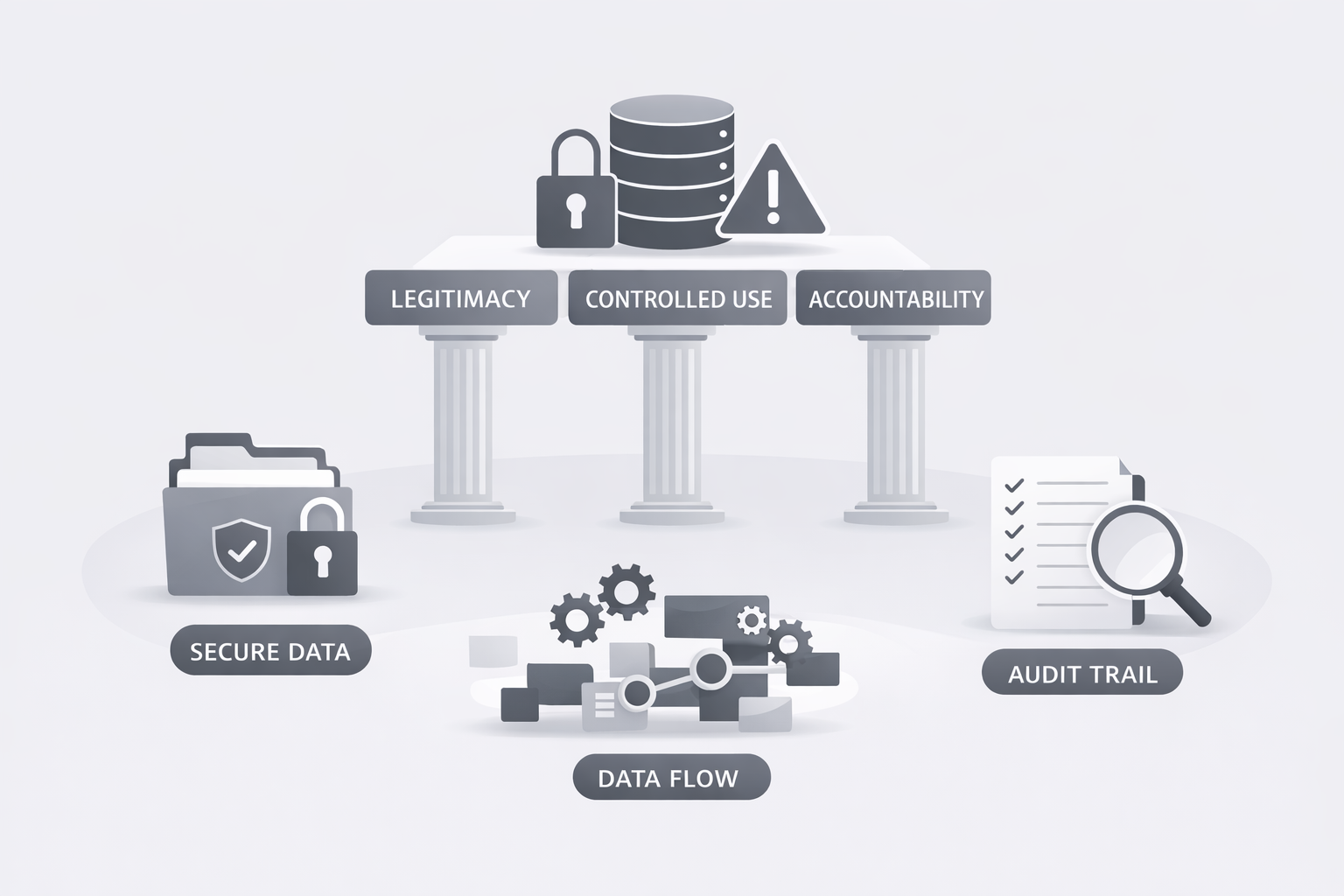
A practical model: three pillars of governance
You can implement governance in many ways. The details vary by company size, industry, and risk profile. The logic stays consistent.
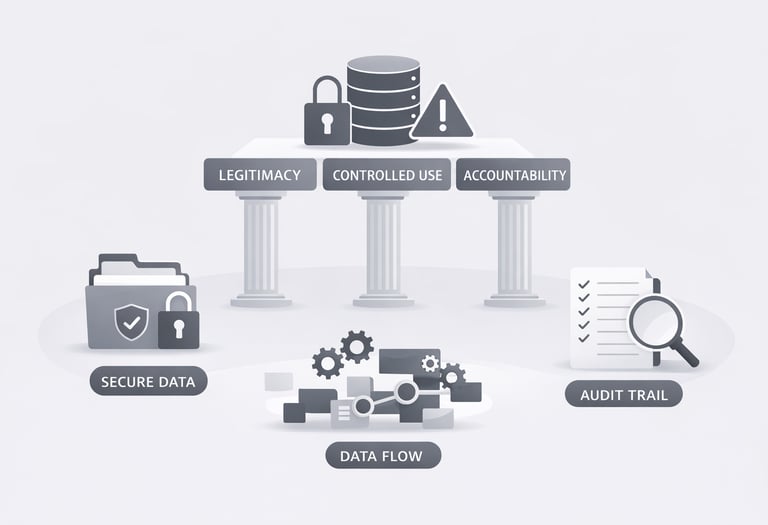
Legitimacy: what data you are allowed to collect and why
Controlled use: how data may be processed, shared, secured, retained, and accessed
Accountability: how you prove it through documentation, traceability, and audit logs
This is how governance stays sane. It stays tied to business value and risk, not endless documentation.
What good looks like in the first 30 days
You do not need a multi-year program to start seeing value. In 30 days, a minimum viable governance setup often includes:
1) Data inventory: A clear list of core data assets, where they live, who uses them, and what business processes depend on them.
2) Data dictionary: Plain-language definitions for key entities and metrics, including business rules like how returns affect “units sold.”
3) Data classification: A practical classification system based on domain and sensitivity, including personal data where relevant, plus handling rules.
4) RACI. Clear accountability: who is Responsible, Accountable, Consulted, and Informed for definitions, access, quality, and changes.
With those four, you stop relying on memory and informal gatekeepers. You create clarity that survives growth, staff changes, migrations, and audits.
The mindset shift that makes governance work
The teams that succeed with governance stop treating it as an external obligation. They treat it as trust-signaling. You can lose trust once. After that, it becomes expensive to earn it back.
Want a quick sanity check?
If you want a fast assessment, book a short call. We will figure out whether your governance is “scale-proof” and “audit-proof,” and what the smallest next step is to create clarity without slowing your teams down.