

If you are a CEO, COO, or business owner, “data governance” only matters if it creates clarity. Can you use your data to run the business confidently, without stepping on legal landmines, harming trust, or arguing over what numbers mean?
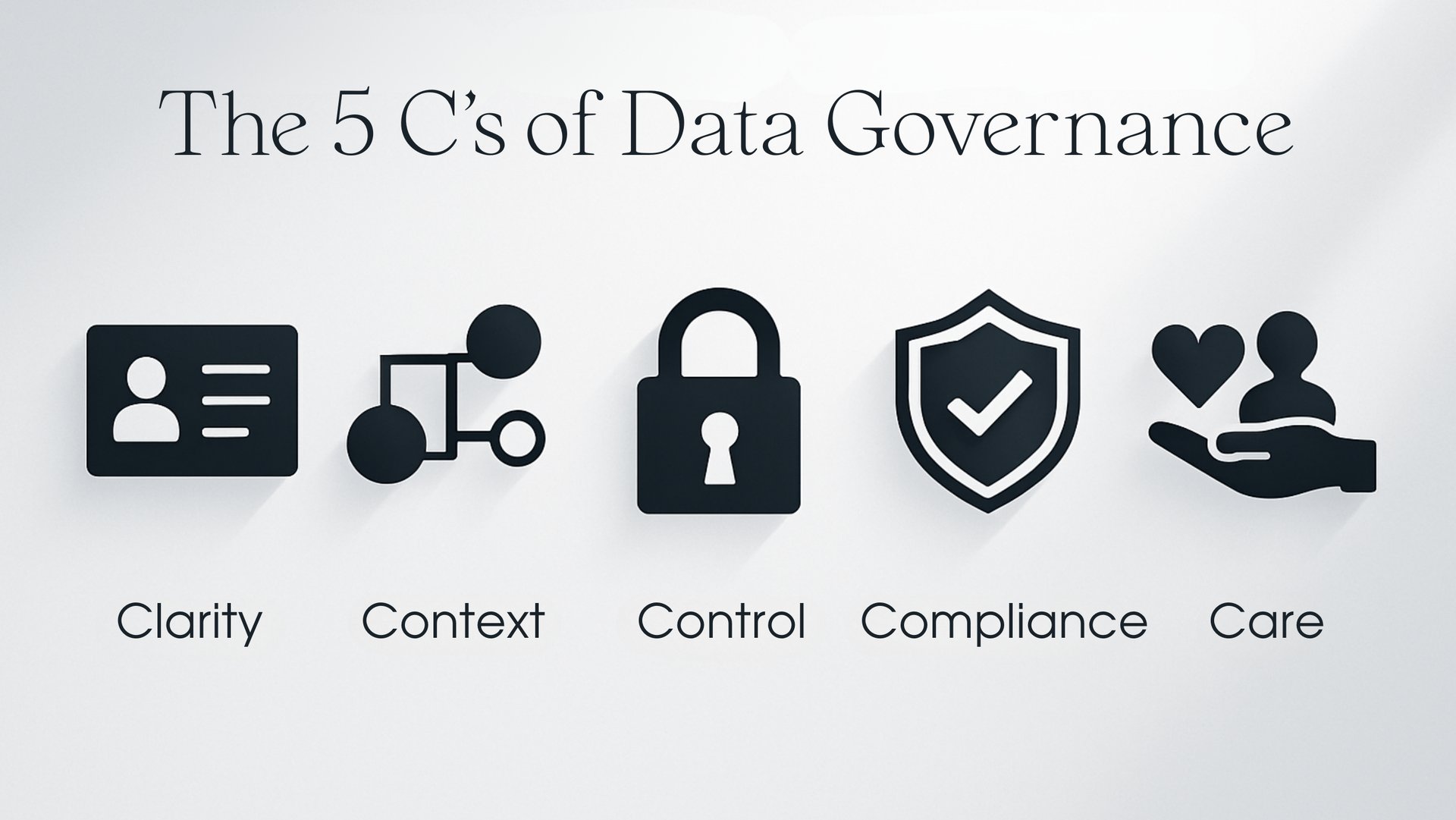
A simple way to make governance practical is the 5 C’s.
Quick note: there is no single universal “official” 5 C’s model. Different teams use different versions. The one below is the one I use when I want governance to be useful, scalable, and human.
The 5 C’s
Clarity
Context
Control
Compliance
Care
Think of them as a system. If you miss one, the others become fragile.
1) Clarity
Clarity answers: What does our data mean, and who is accountable for it?
This is where most “data chaos” actually comes from. Not broken pipelines. Broken meaning.
Clarity includes:
A shared vocabulary for key entities and metrics (data dictionary)
A decision on what is “source of truth” for each critical fact
Clear ownership (who is accountable for definitions, not just pipelines)
A fast Clarity test: pick one metric, like “units sold,” and ask:
What timeframe and timezone?
What counts as sold: contract signed, shipped, invoiced, paid?
What happens when items are returned?
Who approves changes to this definition?
If you cannot answer those quickly, you do not have a dashboard problem. You have a governance gap.
2) Context
Context answers: Where did this data come from, what happened to it, and how should it be interpreted?
Context is what makes data safe to reuse. It prevents “we copied the table, so it must mean the same thing.”
Context includes:
Lineage (how data moved and transformed)
Business rules (edge cases and exceptions)
Data types and constraints (what values are valid)
Timeliness and freshness expectations
Example failure (invented but painfully real):
A team changed a pipeline to “fix” late arriving records. The numbers looked better, but quarter-over-quarter comparisons broke. Nobody had documented the change or the new rule, so leadership lost trust in reporting.
Fix: make transformations traceable, and document the business rule where it lives (not in someone’s head).
3) Control
Control answers: Who can do what with data, and can we prove it?
Control is security plus operability. It is where governance stops being a document and becomes an engineered reality.
Control includes:
Role-based access aligned to actual job roles
Unique user accounts (no shared admin accounts)
Audit logs for sensitive actions
Change traceability for critical datasets and metrics
Automated controls where possible (manual checks do not scale)
A practical rule of thumb:
If a control depends on “remembering to be careful,” it will eventually fail.
4) Compliance
Compliance answers: Are we meeting our legal and regulatory obligations in a provable way?
Compliance is not governance, but governance makes compliance survivable.
Compliance includes:
Data classification (sensitivity and handling rules)
Retention and deletion rules
Consent and purpose boundaries where relevant
Evidence for audits (logs, records, approvals, policies that are actually followed)
Example failure (invented):
A company “had a policy” for retention, but no mechanism to enforce deletion. Years later, they discovered they were storing sensitive historical records with no business need, increasing breach impact and audit risk.
Fix: retention must be operational. A rule with no enforcement is not a rule.
5) Care
Care answers: Even if we can, should we?
This is the pillar most governance frameworks underplay, and it is the one that protects long-term trust.
Care is not rigid morality. It is a practical commitment:
We serve the people whose data we process
We avoid exploitation and harm, even when something is technically legal
Care includes:
Designing for respectful defaults (for example, opt-out is enforced automatically)
Avoiding dark patterns (making access to data intentionally inconvenient)
Preventing “governance as surveillance,” especially for employees
Treating trust as an asset that can be lost once
Example failure (invented):
A company offered customers access to their data only by emailing a spreadsheet “on request.” It was technically possible, but intentionally inconvenient. It did not scale and it signaled a lack of respect.
Better: make access predictable, usable, and scalable. Treat it like product quality, not like a nuisance request.
Minimum viable 30-day plan using the 5 C’s
Week 1: Clarity
Pick 5 to 10 critical metrics and entities
Assign an accountable business owner for each
Write definitions in plain language
Week 2: Context
Document lineage at a “good enough” level
Capture key business rules and edge cases
Record data types and constraints for critical fields
Week 3: Control
Remove shared accounts for sensitive systems
Turn on audit logs for critical actions
Implement role-based access for at least one sensitive dataset
Week 4: Compliance and Care
Classify critical datasets
Define retention rules and an enforcement mechanism
Add one “Care check” to new use cases (Who could be harmed? What is the least creepy version of this?)
A simple scorecard you can use in leadership meetings
For each critical dataset or metric, ask:
Clarity: do we have an agreed definition and an accountable owner?
Context: can we explain lineage and rules?
Control: is access appropriate and auditable?
Compliance: do we meet retention and regulatory obligations?
Care: are we respecting people, not exploiting loopholes?
If you cannot answer one of these, that is your next governance priority.